
In late 2024, Nature Energy published an interlaboratory study of unusual scale. One batch of commercially sourced materials (NMC622 cathode, Li₆PS₅Cl solid electrolyte, indium foil counter-electrode) was distributed to 21 research groups. All participants followed the same electrochemical protocol; the only unconstrained step was cell assembly, where each group used its own equipment and procedures.
The performance spread across nominally identical cells was substantial. The study quantifies a cost that is rarely accounted for in solid-state research and development: when assembly is not standardized, results are not comparable between laboratories.
Round-robin study design
The study design (Puls et al., Nat. Energy 9, 1310–1320, 2024) was deliberately minimal: materials identical, electrochemical protocol fixed, assembly unconstrained. The measured variability concentrated in variables that the field rarely reports:
- Compaction pressure and dwell time: pressing conditions ranged widely across groups, and the same powder batch produced measurably different pellet densities as a result.
- In:Li ratio: with an indium counter-electrode, the degree of prelithiation depends on the lithium content of the indium. Groups differed substantially on this value, which shifts the lithium inventory of the cell.
- Environment and handling: Li₆PS₅Cl evolves H₂S on exposure to moisture. Brief ambient exposure between processing steps degrades the interface at different rates in different laboratories.
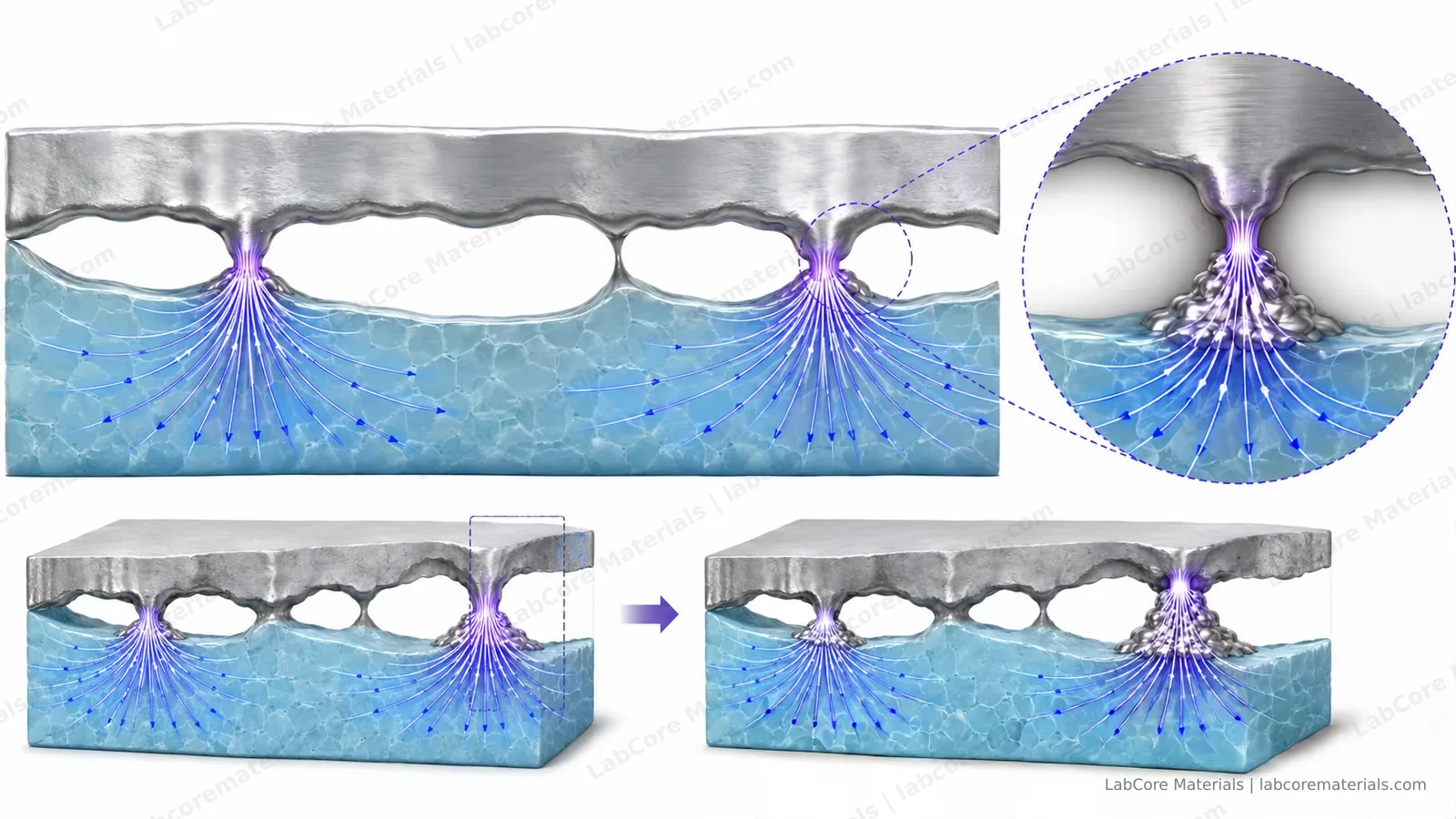
None of these parameters is exotic; each is determined at the press or inside the glovebox within minutes. This is precisely why they are frequently omitted from publications, and why two laboratories that both report "400 MPa" can still produce different cells.
Open-circuit voltage as an assembly quality indicator
The most actionable finding of the study requires no additional equipment. For the NMC622 / Li₆PS₅Cl / In chemistry, cells whose initial open-circuit voltage fell within approximately 2.5 to 2.7 V vs Li⁺/Li showed markedly higher cycling success rates. Cells outside this window could almost always be traced to an assembly fault: insufficient contact, a micro short circuit, or a lithium-inventory deviation.
The procedural implication is direct. The open-circuit voltage of every cell should be measured before cycling begins. A cell outside the expected window should be diagnosed at the assembly stage rather than consuming days of cycler time. Among solid-state testing workflows, this is the closest equivalent to a pass/fail criterion, and it requires only a multimeter.
Minimum reporting fields
The authors propose a parameter set for reporting all-solid-state cycling results. Compiled into a checklist, the minimum requirement is as follows:
| No. | Reporting item | Notes |
|---|---|---|
| 1 | Electrolyte and electrode batch and supplier | Batch-to-batch variability exists |
| 2 | Compaction pressure in MPa | Tonnage values must be converted using the die area |
| 3 | Die diameter or pellet area | Required to verify item 2 |
| 4 | Dwell time at full pressure | Pellet density continues to evolve during holds |
| 5 | Assembly environment (dew point, glovebox H₂O and O₂ levels) | Sulfides may degrade within minutes of exposure |
| 6 | Electrolyte mass and layer thickness | Layer thickness sets the impedance floor |
| 7 | Counter-electrode type; In:Li ratio where indium is used | Determines the lithium inventory |
| 8 | Current collectors and sealing method | Contact and leakage paths |
| 9 | Operating stack pressure and fixture type (rigid or spring-loaded) | Affects the interpretation of cycling data |
| 10 | Open-circuit voltage after assembly | Assembly quality indicator |
| 11 | Test temperature | Ionic conductivity is temperature-dependent |
| 12 | Number of replicate cells and observed spread | Single-cell results lack statistical significance |
Replicate cells and reported spread
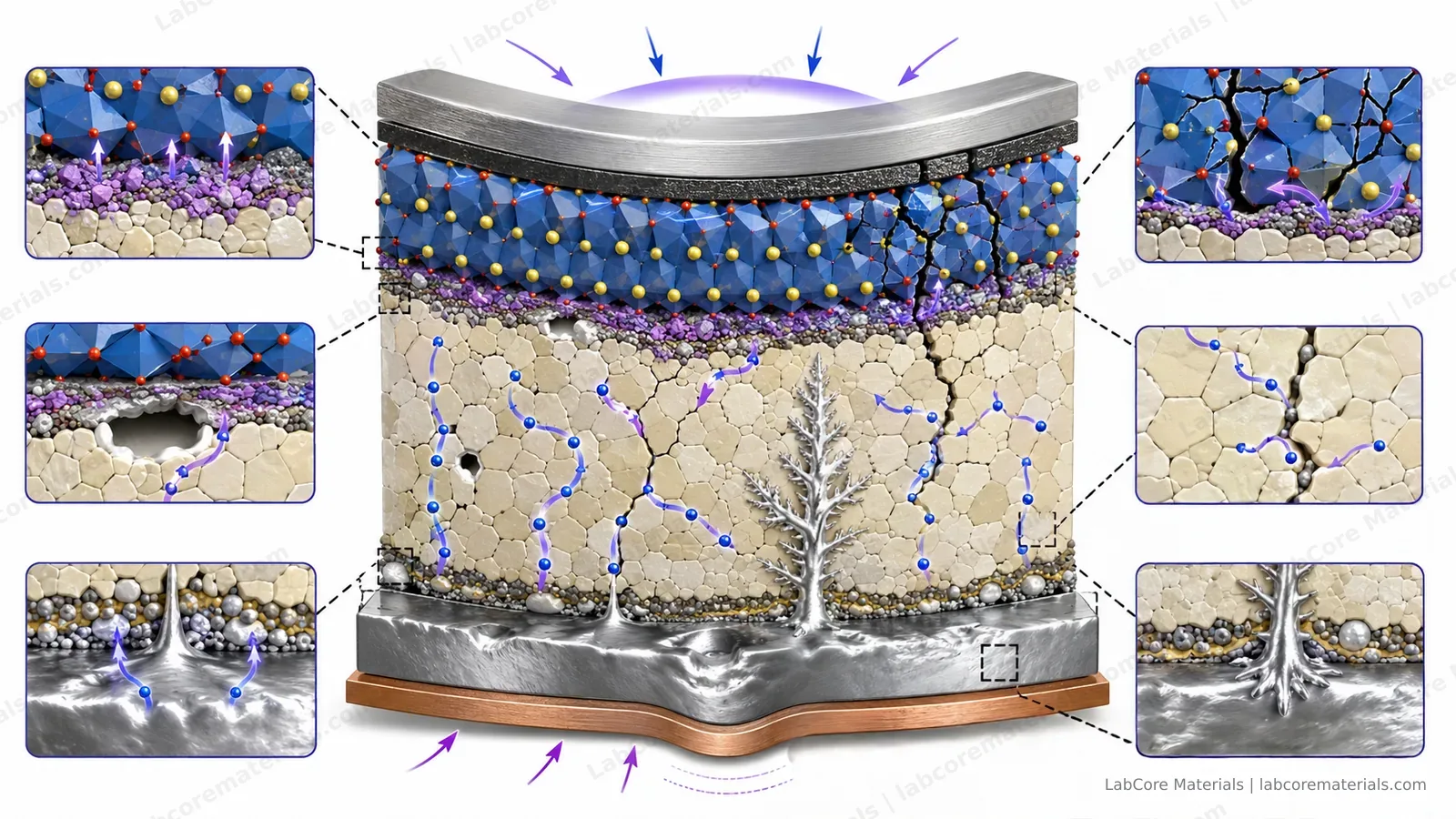
The second recommendation is equally important: cycling data should be reported in triplicate. In liquid-electrolyte testing, cell-to-cell scatter is small enough that a single cell is often representative. In solid-state testing, where assembly dominates the variability, a single cell does not constitute a statistically meaningful result. Three replicate cells with a reported spread convert a single observation into citable evidence.
Hardware factors in assembly consistency
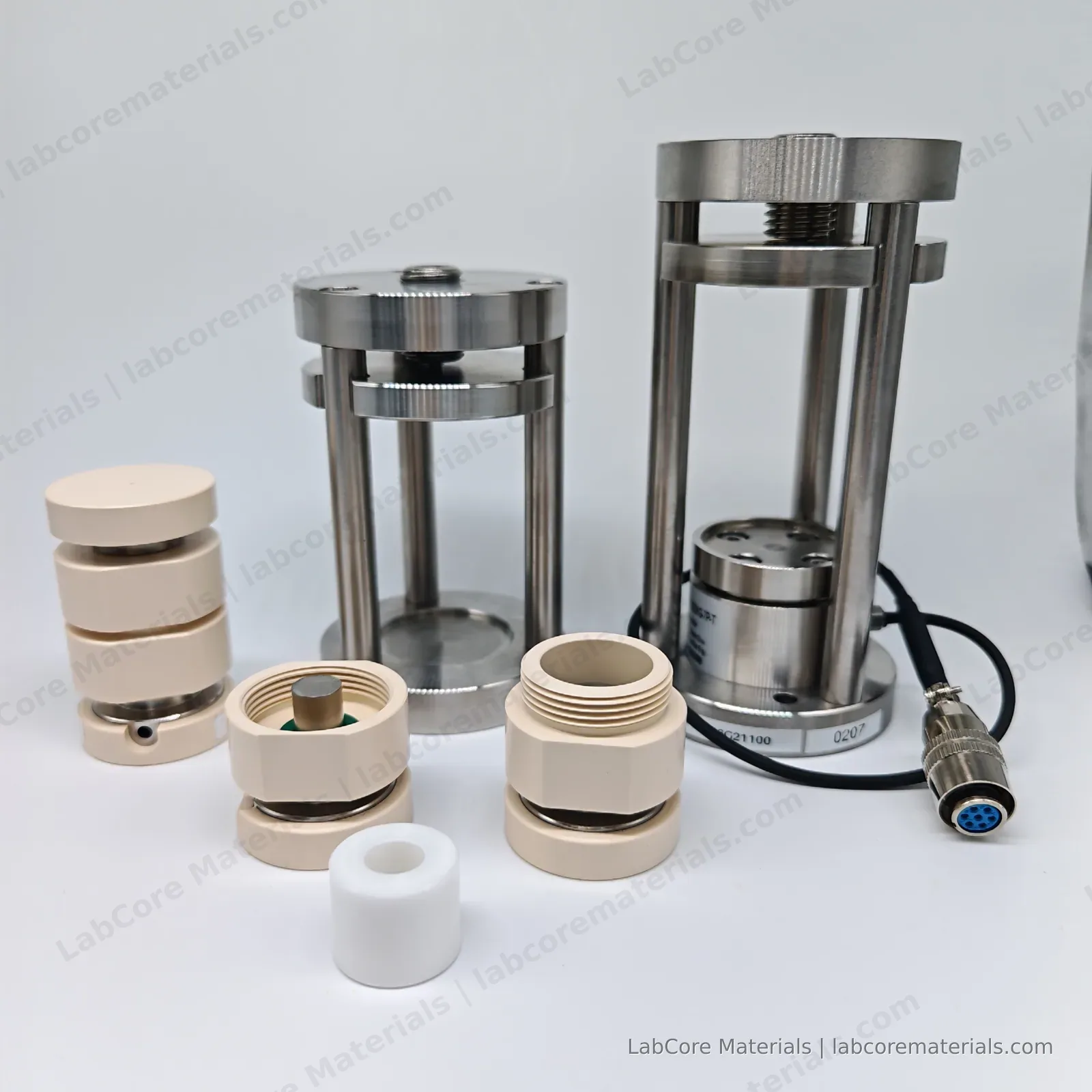
A substantial share of the variability described above originates in tooling rather than in operator technique. Two groups of equal skill will produce different compaction if one reports the press gauge reading while the other measures the actual force delivered to the pellet.
- Dies with an integrated force sensor convert a nominal pressure into a measured one. The single-point pressing mold (MOL5B100A) is designed for this purpose, with a force sensor option covering 500–5000 kg.
- Controlled unloading is as relevant as controlled pressing. Brittle pellets crack under abrupt pressure release, and such cracks surface later as impedance drift. A locking-ring fixture that releases load evenly (DLK-MOL1B100A) removes this variable from the workflow.
- Consistent stack pressure during cycling completes the set. A three-point pressing fixture (MOL5A100A) holds distributed load on the stack so that all replicate cells share the same mechanical history.
These measures do not replace parameter reporting. Their role is to make the reported values accurate and to keep the replicate spread small enough to be meaningful.
Further reading
Two fields of the checklist are examined in depth in separate articles:
- Items 2 and 9 (pressure): Solid-State Stack Pressure: How Much, How to Apply, How to Report
- Item 5 (environment and interface chemistry): Interface Problems in Sulfide Solid Electrolytes
References
- Puls, S. et al. Benchmarking the reproducibility of all-solid-state battery cell performance. Nat. Energy 9, 1310–1320 (2024). DOI: 10.1038/s41560-024-01634-3
- Randau, S. et al. Benchmarking the performance of all-solid-state lithium batteries. Nat. Energy 5, 259–270 (2020). DOI: 10.1038/s41560-020-0565-1