
The workhorse with a systematic bias
Coin cells are the default format for materials screening, and they should be. They are fast, they consume milligrams of material, and one person can assemble dozens in an afternoon. The problem is not that coin cell data is useless — it is that coin cell data answers a slightly different question than the one most people are asking.
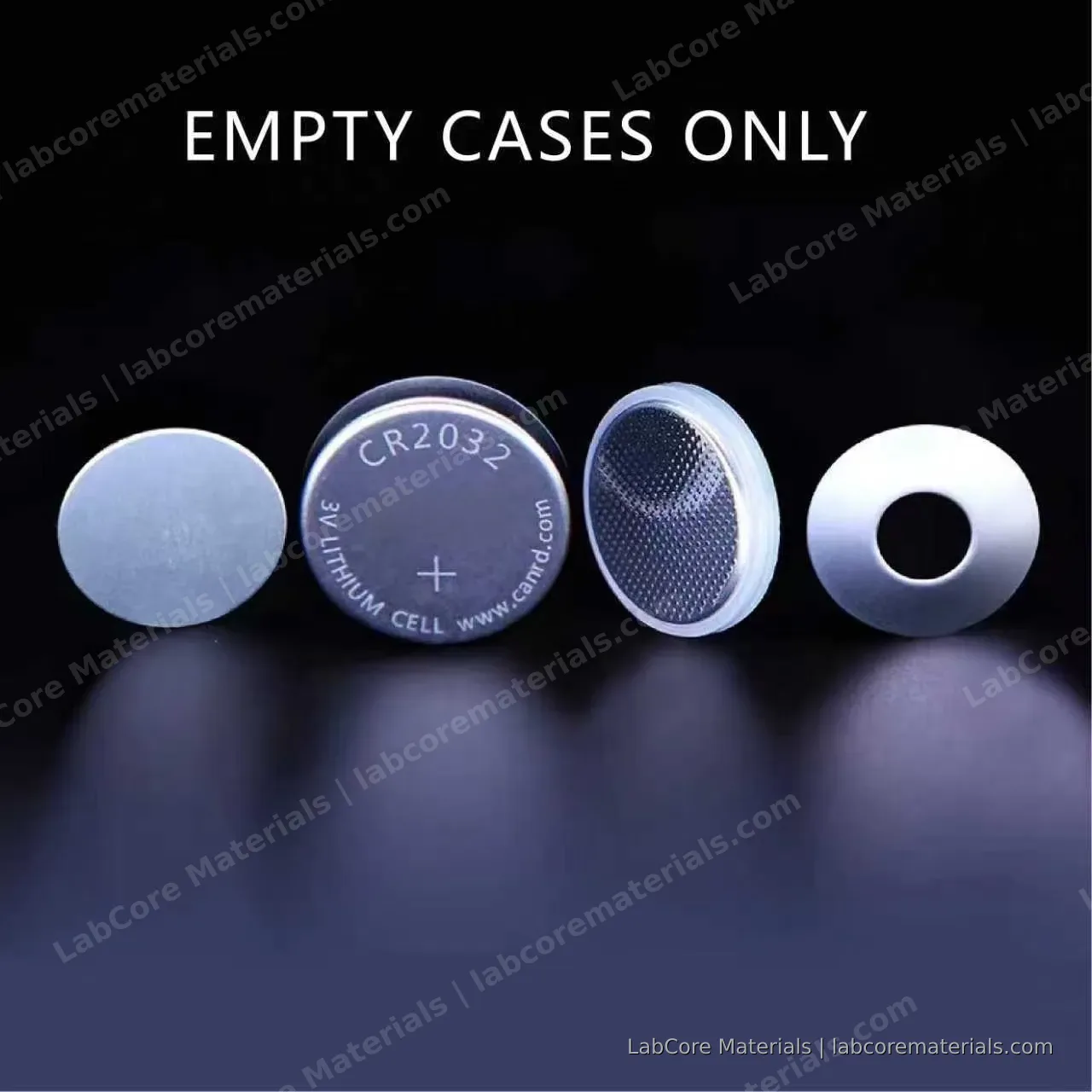
A coin cell tells you how a material behaves when lithium is unlimited, electrolyte is abundant, and pressure is whatever the wave spring happens to deliver. A commercial cell offers none of these conditions. If you read coin cell curves as predictions of full-cell behavior, the gap will show up in the metrics that matter most: cycle life, gas generation, and rate capability.
Three factors cause most of the gap. All three can be measured, and two of them can be corrected without leaving the coin cell format.
Factor 1: The N/P ratio you forgot you set
In a graphite or silicon full cell, the negative electrode is deliberately sized 5–20% larger than the positive — an N/P ratio of roughly 1.05–1.2. That margin exists because lithium inventory is consumed by SEI growth and other side reactions. When the inventory is gone, the cell fades fast, no matter how healthy the cathode is.
In a half cell against lithium metal, the negative side is effectively infinite. The N/P ratio is not 1.1 — it is not even a number. Every microgram of lithium the cathode loses is silently replaced from the foil.
The consequence: half cells cannot see lithium inventory loss. A cathode coating that looks stable for 500 cycles in a half cell may still be consuming lithium fast enough to kill a full cell in 200. This is the single most common reason a "stable in half cell" material disappoints at the pouch level.
What to do about it:
- If the question is cathode cycling stability, run a full cell against graphite or a lithium-free anode once the half-cell screen passes. It is slower and messier, and it is the only configuration that measures what you actually ship.
- If you must stay in half cells, treat them as a ranking tool, not a life predictor. A material that beats another by 30% in half-cell cycling often beats it by less in full cells — but the ranking usually survives.
Factor 2: Electrolyte, 10–20 times too much of it
A well-loaded research coin cell (2–4 mAh/cm², 15.6 mm electrodes) typically gets 60–120 µL of electrolyte — an E/C ratio of roughly 15–30 µL/mAh. Commercial cells run 1–3 µL/mAh. Your lab cell contains 10–20 times more electrolyte than the product you are trying to predict.
Excess electrolyte changes the test conditions in specific ways:
- Wetting never limits anything. Dry-out, the dominant failure mode in lean-electrolyte cells, essentially cannot happen.
- Impedance growth from electrolyte decomposition is diluted. The same amount of decomposition products dissolves into a much larger reservoir.
- Rate capability looks better. Ionic path resistance stays low because there is plenty of ions to carry the current.
A formulation that delivers 1,000 cycles at high E/C may deliver a fraction of that at commercial fill ratios, because the electrolyte itself becomes the consumable.
What to do about it:
- Report the E/C ratio in every paper and internal report, not just the volume. It is the quantity that transfers between cell formats.
- For critical comparisons, deliberately run a lean-electrolyte arm (5–10 µL/mAh) alongside the default. If your material survives both, the result is much more likely to survive scale-up.
- Our CR2032 assembly guide and the electrolyte dosing guide cover the practical dosing procedure.
Factor 3: Stack pressure, the number nobody writes down
The wave spring inside a CR2032 delivers somewhere in the range of tens of kPa to under 1 MPa — and the exact value depends on the spring, the stack height tolerance, and how deep the crimp went. Most labs never measure it. Most papers never report it.
Meanwhile, the processes you care about are pressure-sensitive:
- Interface contact scales with pressure. Poor contact reads as "high impedance" and "inconsistent capacity", when the real cause was low spring force on that day.
- Solid-state cells are an order of magnitude short. Sulfide electrolytes typically need 10–100 MPa to form and maintain contact — completely out of reach for a coin cell spring. This is why solid-state screening moves to dedicated molds with hydraulic or screw-driven pressure, where 500 MPa is standard.
- Lithium metal creeps. At low pressure, Li-metal anodes develop uneven contact that seeds dendrites differently than a well-pressed stack.
What to do about it:
- Control what you can: use matched spacers and springs, keep stack height tolerance tight, and crimp with a calibrated fixture. Consistency matters more than the absolute value.
- If pressure affects your conclusion — lithium metal, silicon, any solid electrolyte — move to a pressure-controlled fixture and report the value. Coin cells cannot answer pressure questions; they can only be confounded by them.
What coin cells are actually for
None of this makes coin cells the wrong tool. It makes them a specific tool:
| Question | Coin cell answer quality |
|---|---|
| Does material A beat material B? (same loading, same everything) | Good — this is the correct use |
| What is the reversible capacity and voltage profile? | Good |
| How many cycles will the full cell last? | Poor — inventory and electrolyte effects dominate |
| Rate capability in a lean, compressed cell? | Poor — excess electrolyte flatters the result |
| Anything involving stack pressure? | Not answerable in this format |
The rules that make coin cell data transferable are boring but effective: fix the areal loading at a commercially relevant 2–4 mAh/cm² instead of the easy 1, keep E/C constant across a series, run n ≥ 3 and report the spread, and write down the separator, electrolyte volume, and spring type for every batch. None of this costs more than a few minutes per cell.
When to move up a format
Move to single-layer pouch or stack cells when the question involves lithium inventory, lean electrolyte, gas generation, or pressure. Those formats cost more per cell and forgive less — which is exactly the point. The industry pattern that works is two-stage: coin cells to rank and eliminate, then a small number of pouch cells to confirm the survivors. Labs that skip the second stage end up learning the same lessons twice, once in the coin cell and once, expensively, at pilot scale.
If you are setting up a coin cell line for screening, the CR2032 kit with matched 304 stainless cases, springs, and spacers removes one variable — hardware consistency — from the long list above.
Questions about cell format selection or pressure-controlled testing? Contact the team.