LabCore Materials
CR2032 Coin Cell Case Kit for Battery Research | LabCore
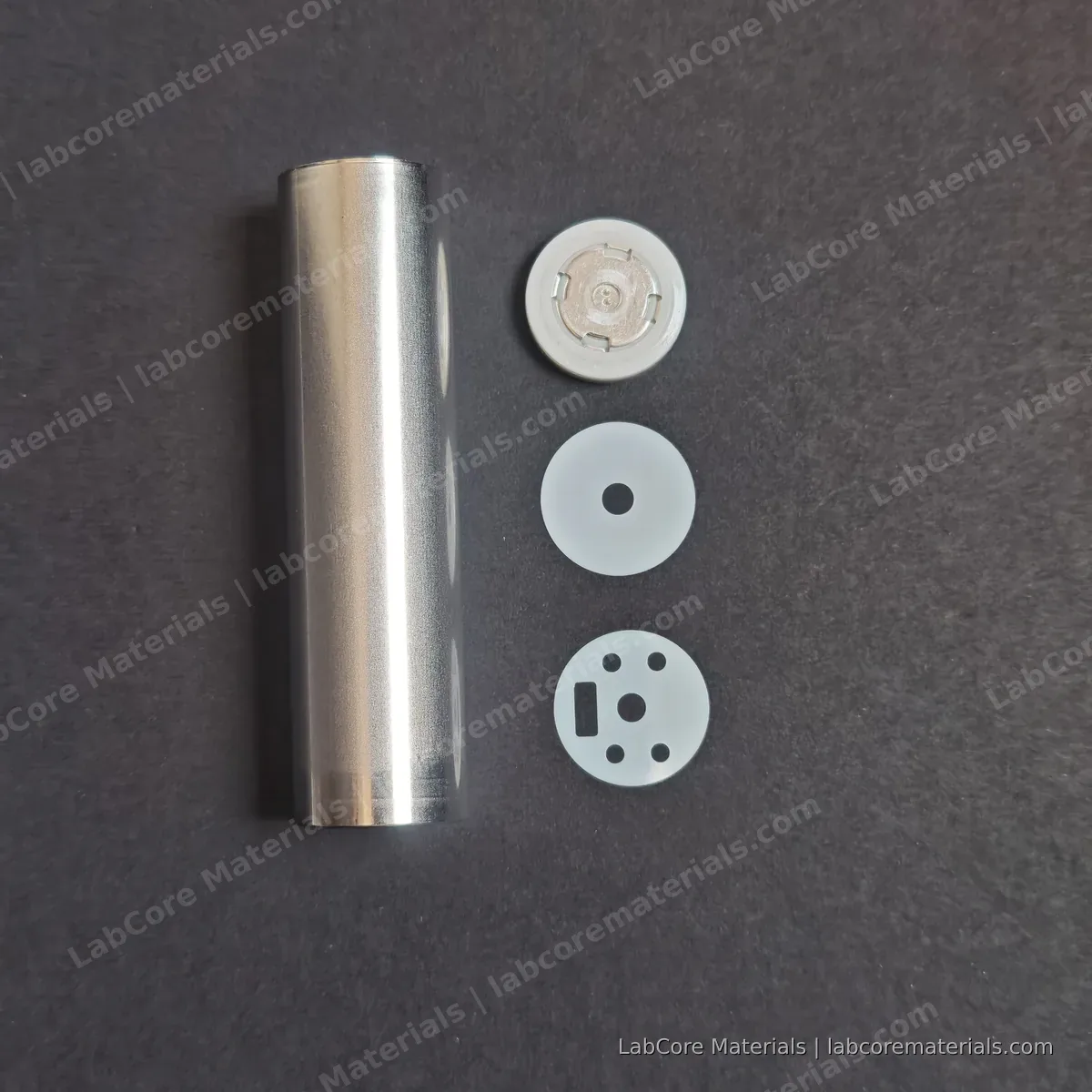
Complete CR2032 coin cell assembly kit: positive case, negative case, spring and spacer. 100 sets per pack.
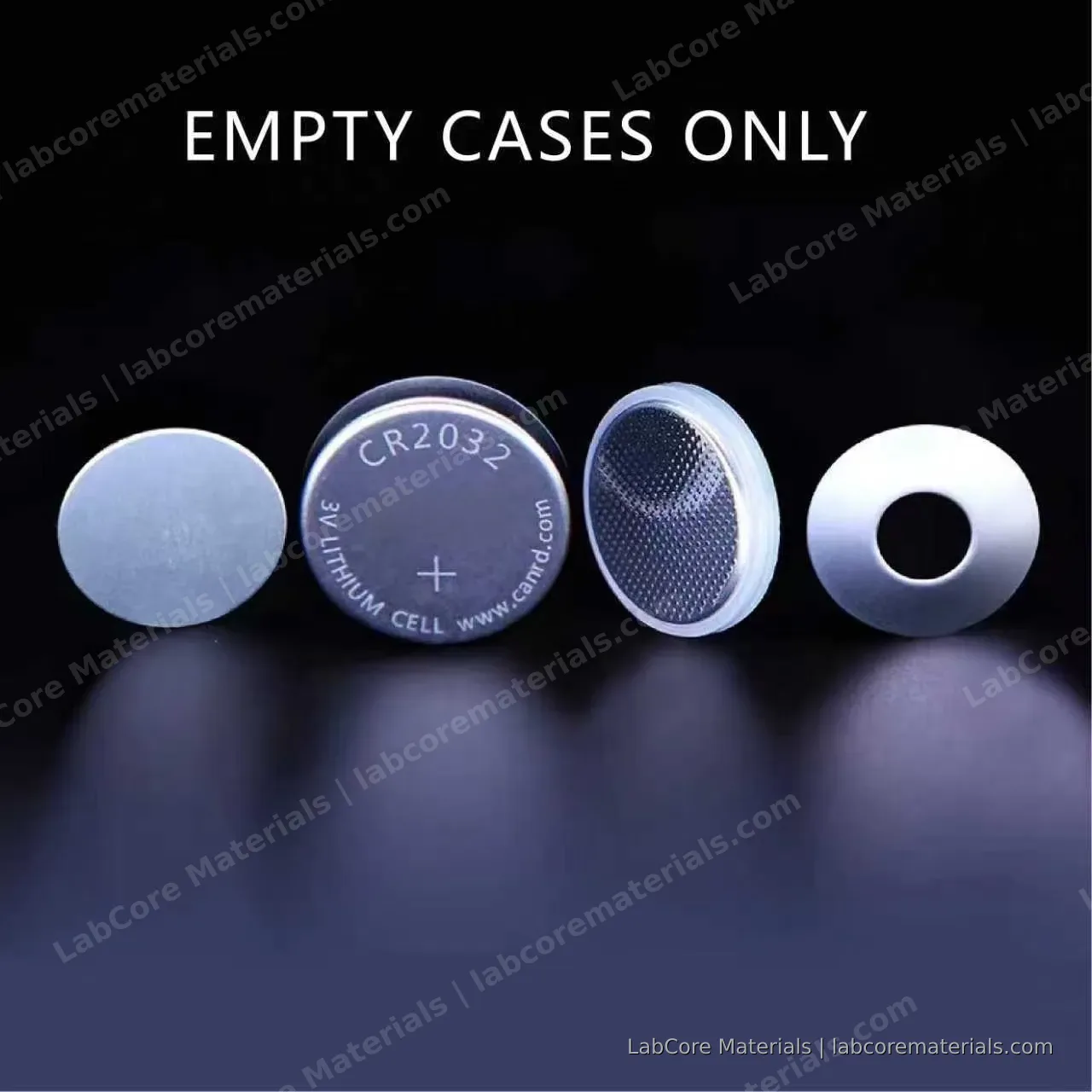
Our CR2032 coin cell case kit is designed specifically for battery research applications.
Each kit includes precision-engineered stainless steel cases, sealing gaskets, and wave
springs for reproducible cell assembly. Ideal for testing electrode materials, electrolytes,
and cell configurations in university and R&D laboratories.
【Complete Set】: Includes 100 positive cans, 100 negative cans, and 100 pre-installed PP O-rings, providing everything needed for standard CR2032 coin cell assembly.
【Premium Material】: Constructed from high-quality 304 stainless steel, offering excellent corrosion resistance and chemical stability for battery research.
【Precision Sealing】: Pre-assembled with polypropylene (PP) O-rings to ensure exceptional airtightness and prevent electrolyte leakage.
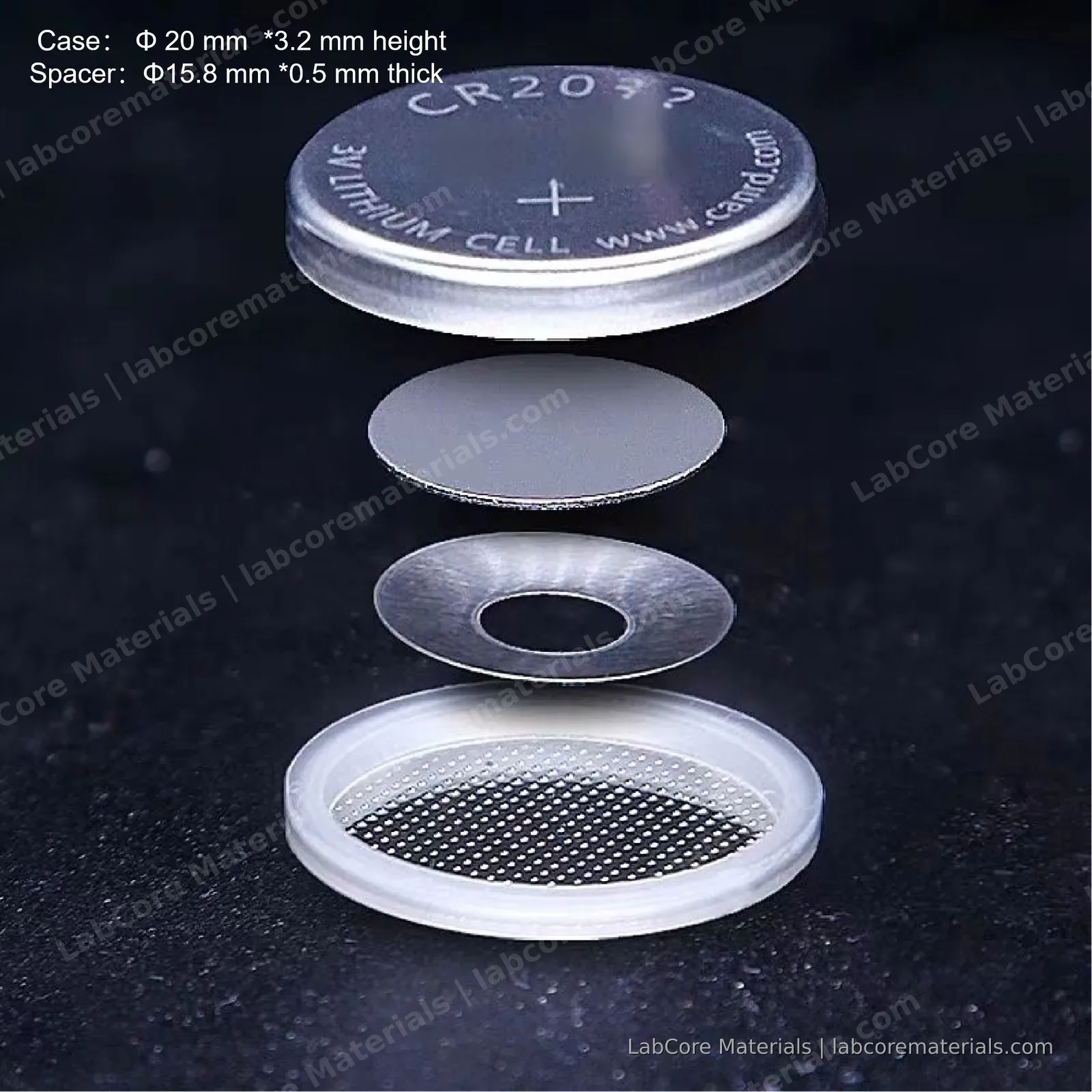
【Standard Dimensions】: Strictly manufactured to standard CR2032 specifications (20mm diameter, 3.2mm thickness), perfectly compatible with standard crimping machines.
【Lab Essential】: Ideal for R&D of lithium-ion batteries, solid-state batteries, and supercapacitors in university labs and research institutes.
Related Guide: [CR2032 Coin Cell Assembly Guide](/resources/cr2032-coin-cell-assembly-guide/)
Order / Quote
| Model | Pack | Price | Action |
|---|---|---|---|
| CR2032-KIT-100In stock · Amazon | CR2032 Coin Cell Kit, 100 sets100 sets per pack (100 × positive case, 100 × negative case, 100 × spring, 100 × spacer) | $35.00 | Buy on Amazon 1000+ units: request wholesale pricing → |
Specifications
| Parameter | Value | Unit |
|---|---|---|
| Format | CR2032 | |
| Set contents | Positive case + negative case + spring + spacer | |
| Pack size | 100 sets |
Ideal for R&D of lithium-ion batteries, solid-state batteries, and supercapacitors in university labs and research institutes.
How It Works
- Reading a Battery's Impedance Spectrum: What Each Region of the Nyquist Plot Actually MeasuresWhat a small sinusoidal perturbation probes at each frequency, which physical process sits behind the ohmic intercept, the SEI arc, the charge-transfer arc and the Warburg tail — and the measurement practices that keep those assignments honest.
- Why Coin Cells Give You Wrong NumbersCoin cell results often fail to predict full-cell behavior. Three structural causes — unlimited lithium inventory, 10–20× excess electrolyte, and uncontrolled stack pressure — explain most of the gap, and each one can be partially corrected in the lab.
Setup & Troubleshooting
- How Much Electrolyte Goes in a CR2032?A dosing range for every purpose — screening, rate tests, long cycling, sulfides — how to calculate it from E/C ratio, and the failure symptoms that tell you the volume was wrong before the data is.
- Aluminum Laminated Film for Pouch Cell Research: Structure, Properties, and HandlingA practical guide to understanding aluminum laminated film for pouch cells: the three-layer structure, what each layer does, heat sealing parameters, and how to handle and store the material without damaging it.
- CR2032 Coin Cell Assembly Guide for Research LabsA complete guide to assembling research-grade CR2032 coin cells: component functions, correct stack order, crimping technique, and how to diagnose common failure modes.
Compare & Choose
- CR2032 vs CR2025 vs CR2016: What Are the Differences?Same 20 mm diameter, same lithium–manganese dioxide chemistry — the three formats differ only in height, and capacity, weight and hardware compatibility follow that one dimension. Parameter comparison, the physics behind the capacity numbers, and how the difference plays out in laboratory coin cell hardware.
- CR2032 vs CR2025 vs CR2016: Which Coin Cell Size for Your Battery Research?A complete comparison of CR2032, CR2025, and CR2016 coin cell sizes for research applications: dimensional specs, capacity differences, impedance characteristics, and how to choose the right size for your electrochemical testing.
- 18650 Battery Case for Research: What the Specifications Actually MeanA practical guide to choosing 18650 cylindrical cell hardware for laboratory use: why stainless steel matters, what the vented cap does, and how to assemble and verify your cells.
Product Images
Shipping & Compliance
- Non-Amazon orders ship from our Shenzhen facility via DHL / FedEx — typically 5–10 business days in transit to the US and EU, with tracking. Bulk orders may go by air freight.
- Ships as empty hardware. No electrolyte, no lithium. Not classified as dangerous goods.
FAQ
Does the CR2032 kit include gaskets?
Yes. Each set includes: 1 positive case, 1 negative case, 1 PP gasket, 1 stainless steel spring, and 1 spacer. The gasket is made from polypropylene (PP), offering good chemical stability with most electrolyte systems.
What's the difference between 304 and 316 stainless steel? Which should I choose?
304 stainless steel (18-8) is the most common research-grade material—cost-effective and suitable for 90% of lithium battery studies. 316 stainless steel (18-10-2, with 2% molybdenum) offers superior corrosion resistance, ideal for high-chloride environments or seawater battery research. For standard Li-ion or solid-state batteries, 304 is perfectly adequate.
How much crimping force do I need?
Recommended crimping force: 800-1200 kg (0.8-1.2 T). Too low causes poor sealing and leakage; too high deforms the case and damages the gasket. Manual crimpers typically deliver the right force when fully actuated. For motorized crimpers, start testing at 1000 kg.
Can I use this kit for solid-state batteries?
Yes, but with limitations: CR2032 cases can't sustain high pressure (only ~1 T during crimping), so they're unsuitable for all-solid-state batteries requiring 50-500 MPa stack pressure. For solid electrolytes needing continuous high pressure, use our PEEK split-cell molds. CR2032 works for polymer solid-state batteries or quick tests with pre-pressed solid electrolyte pellets.
How long will 100 sets last?
Depends on your testing frequency. Typical research groups (10-20 cells/month) can expect 5-10 months. High-throughput labs (10+ cells/week) will use them in 2-3 months. Cases can be cleaned and reused 2-3 times if not shorted or severely deformed, but gaskets and springs are single-use.