
CR2032, CR2025 and CR2016 share the same 20 mm diameter and the same lithium–manganese dioxide chemistry. The difference is height: 3.2 mm, 2.5 mm and 1.6 mm. Capacity, weight and the mechanical stack inside the hardware all follow from that one dimension.
Three key points
- The four-digit code states the dimensions: C for the lithium–MnO₂ chemistry (3 V nominal), R for round, then diameter and height in tenths of a millimeter — CR2032 is 20.0 mm across and 3.2 mm tall.
- Capacity scales with thickness because the MnO₂ cathode volume does: 210–240 mAh for CR2032, 150–170 mAh for CR2025, 75–100 mAh for CR2016.
- The three formats are interchangeable in diameter but not in height. In laboratory coin cell hardware, the stack height — and the compensation provided by springs and spacers — decides which format works.
The naming rule
The IEC 60086-2 designation encodes the geometry directly. C identifies the lithium–manganese dioxide primary system with a nominal voltage of 3 V. R identifies a round cell. The first two digits give the diameter in millimeters (20.0 mm for all three), and the last two digits give the total height in tenths of a millimeter: 32 → 3.2 mm, 25 → 2.5 mm, 16 → 1.6 mm.
Parameter comparison
| Parameter | CR2032 | CR2025 | CR2016 |
|---|---|---|---|
| Diameter | 20.0 mm | 20.0 mm | 20.0 mm |
| Total height | 3.2 mm | 2.5 mm | 1.6 mm |
| Typical capacity (commercial cell) | 210–240 mAh | 150–170 mAh | 75–100 mAh |
| Typical weight | ~3.0 g | ~2.5 g | ~1.8 g |
| Nominal voltage | 3 V | 3 V | 3 V |
| Chemistry | Li / MnO₂ | Li / MnO₂ | Li / MnO₂ |
| Typical use | Motherboard RTC, key fobs, medical devices | Slim remotes, small sensors | Ultra-slim devices, watches |
Why thickness sets the capacity
In a Li / MnO₂ cell, capacity is fixed by the amount of cathode material inside. The cathode — MnO₂ powder with conductive carbon and binder — occupies a cylinder 20 mm across, and its thickness is the cell height minus the can walls, the lithium foil and the separator. Going from 3.2 mm to 2.5 mm removes roughly a third of the active volume; going to 1.6 mm removes about half. The capacity figures in the table track this volume almost linearly, which is why the three formats differ by close to 2× in capacity despite identical chemistry and diameter.
The lithium anode, separator and electrolyte scale down with the same logic but contribute less to the volume budget; the MnO₂ layer is the main reservoir.
Interchangeability
The three formats share the 20 mm diameter, so they fit the same holders and battery contacts in the diameter direction. The height is where substitution fails:
- Spring-loaded compartments (most testers, motherboard holders) tolerate all three heights; the spring simply compresses less for thinner cells. Contact pressure drops accordingly, which matters at higher discharge currents.
- Rigid or snap-fit compartments accept only the specified height. A thinner cell rattles; a thicker one does not close.
- Series stacking raises voltage (two CR2032 in series give 6 V) but never capacity, and mixing formats in a stack puts uneven pressure on the thin cell — not recommended.
The laboratory view: coin cell hardware
For research assemblies, the same logic applies to the hardware rather than the finished cell:
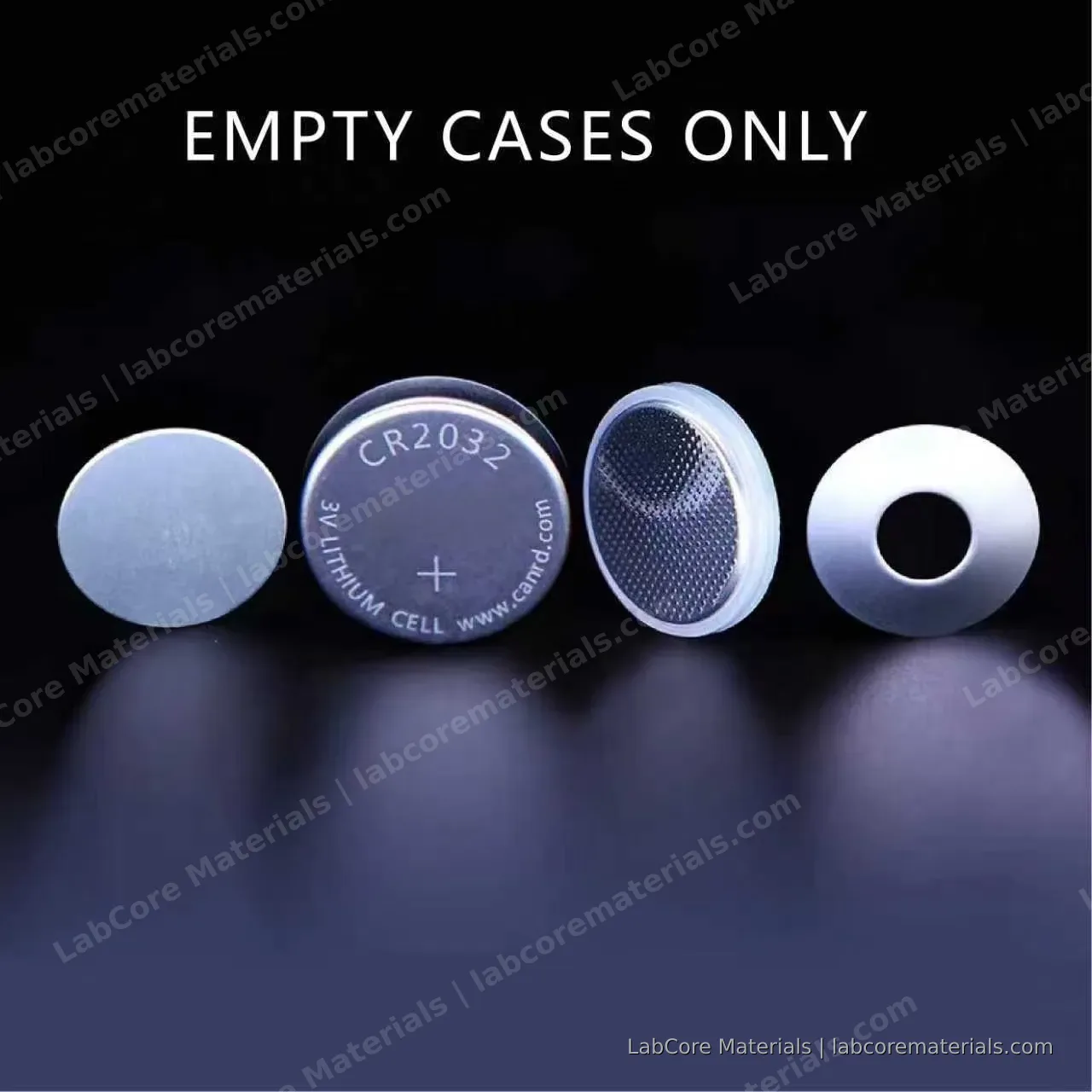
- CR2032 cases are the standard laboratory format. The internal depth accommodates a full stack — electrode disc(s), separator, spacer and spring — which is why capacity tests, cycling studies and solid-electrolyte evaluations are almost universally built on 2032 hardware.
- CR2025 cases are 0.7 mm shallower. They suit thin stacks: symmetric lithium cells, single-layer electrode screening, or configurations where fewer spacers are acceptable. Our CR2025 case sets ship with a funnel-shaped spring (OD 15.4 × 1.1 mm) and a 0.5 mm spacer (OD 15.8 mm) to cover typical stack compensation.
- CR2016 cases are uncommon in laboratories: at 1.6 mm total height, the internal space rarely fits a complete research stack. They are mainly relevant when reproducing commercial CR2016 formats.
Our range currently covers CR2032 case kits (100 positive cans, 100 negative cans, PP O-rings pre-installed, 304 stainless steel) and CR2025 case sets (100 sets with spring and spacer). CR2016 hardware is not a standard stock item.
Assembly notes
- Stack height below the available space leaves the interface under-compressed — contact resistance rises and measured capacity drops. See why coin cells give you wrong numbers.
- Stack height above the available space prevents complete crimping, and the PP O-ring cannot seal.
- Spacers are the adjustment knob: add or remove to bring the stack into the crimp window.
- For case material selection (304 vs 316 stainless steel, coating), see the dedicated comparison.
References
- IEC 60086-2:2021, Primary batteries — Part 2: Physical and electrical specifications. International Electrotechnical Commission. (Defines the CR-series dimensions and discharge characteristics.)
- Park S, Savvides A, Srivastava M. Battery capacity measurement and analysis using lithium coin cell battery. Proceedings of the 2001 International Symposium on Low Power Electronics and Design (ISLPED), 2001: 382–387. DOI: 10.1145/383082.383187
Conclusion
The three formats differ in exactly one dimension — height — and capacity follows the cathode volume that height provides: 210–240 mAh (CR2032), 150–170 mAh (CR2025) and 75–100 mAh (CR2016). In commercial use the choice is set by the device cavity; in laboratory work it is set by the stack the hardware must accommodate. CR2032 cases remain the default for research because their internal depth fits a complete electrode–separator–spacer–spring stack, and CR2025 cases cover the thin-stack configurations between.
Step-by-step assembly practice for the 2032 format: CR2032 coin cell assembly guide.