
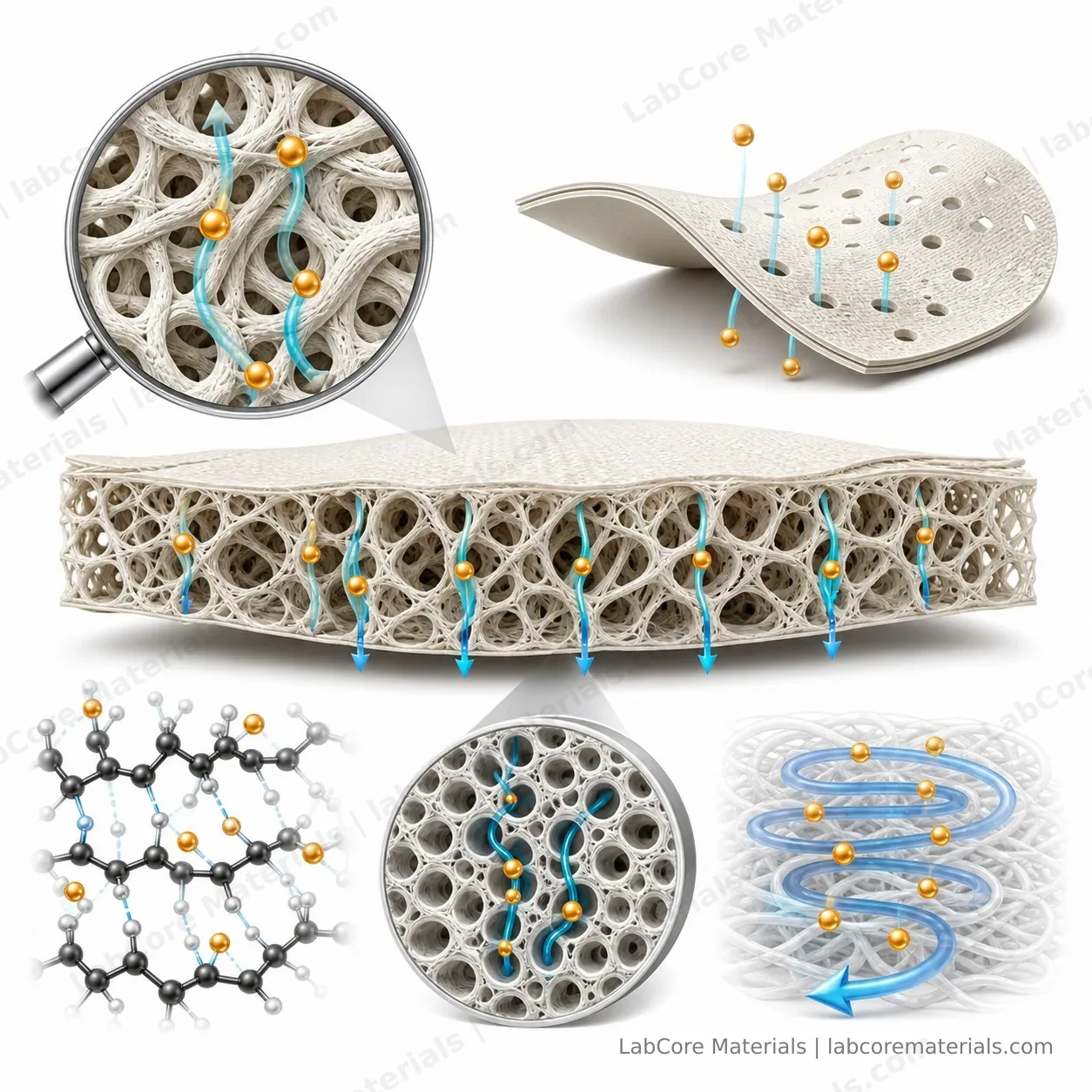
Pick a separator by chemistry first and by thickness second — and thickness is where most labs hesitate. The three most common polyolefin grades in lab-scale work are 20 µm, 25 µm and 38 µm trilayer membranes. The differences look small on a datasheet; in a cell they decide your internal resistance, your energy density, and whether a dendrite ends your experiment in cycle 40 or cycle 400.
The Three Grades at a Glance
| Property | 20 µm (2320) | 25 µm (2325) | 38 µm (2340) |
|---|---|---|---|
| Structure | PP/PE/PP trilayer | PP/PE/PP trilayer | PP/PE/PP trilayer |
| Thickness | 20 µm | 25 µm | 38 µm |
| Porosity | 39% | 39% | 45% |
| Air permeability (Gurley, s/100cc) | 530 | 620 | 780 |
| Puncture strength | baseline | baseline | ≥ 500 g, roughly +30% vs 25 µm |
| TD shrinkage @90 °C | low | low | ≤ 0% |
| Thermal shutdown (PE layer) | Yes | Yes | Yes |
| Best for | max energy density, thin stacks | general coin-cell work | mechanical margin, high load, solid-state |
Data source: Celgard technical specifications (2320/2325/2340 series)
All three are dry-process trilayers: two porous PP skins around a PE core. The PE layer is the safety feature — it melts around 130 °C and closes its pores before the PP skins fail, cutting off ion transport during a thermal event. Any grade in this comparison gives you shutdown behavior; a monolayer PP membrane (like our 2500) does not.
What Thickness Actually Changes
Ion transport: thinner is faster
Gurley air-permeability time tracks how easily gas — and by extension, ions — moves through the pore network. Our numbers: 530 s (20 µm), 620 s (25 µm), 780 s (38 µm). Thinner membranes also mean a shorter ionic path, so area-specific impedance drops roughly in proportion. For rate-capability work in coin cells, the 20 µm grade measurably lowers internal resistance versus the 38 µm grade.
Mechanical strength: thicker survives more
The 38 µm membrane carries roughly 30% higher puncture strength than the 25 µm grade, and the gap widens further against 20 µm. This matters in three situations: high stack pressure (solid-state assemblies routinely run 5–100 MPa), lithium-metal anodes where dendrite tips load the separator locally, and large-format pouches where handling abuse is routine. If your separator is the component that fails first, you bought the wrong thickness.
Energy density: thinner buys volume
In an 18 mm coin cell the active stack is short, so separator volume is a small fraction — the difference between 20 µm and 38 µm is a few percent of stack height. In wound or stacked pouch cells the effect compounds with every turn of the winding. Rule of thumb: below 100 mAh cells, choose thickness for performance; above that, energy density starts arguing for thinner.
Dimensional stability
The 38 µm grade's TD shrinkage at 90 °C is ≤ 0%. When you are pressing a solid-state stack or running elevated-temperature cycling, a membrane that holds its dimensions keeps your alignment — and your data — intact.
Grade by Grade: When Each One Wins
20 µm — when the rate is the result
Choose the 20 µm grade (2320) when the experiment measures rate capability or fast-charge behavior, when the cell is small (16–20 mm discs) and hand assembly is gentle, and when every micron of stack height counts. Its lower Gurley number translates directly into lower area impedance. The trade-off is mechanical: it punctures more easily, and aggressive holders or burr-edged cases will find that out for you.
25 µm — the default that is rarely wrong
The 25 µm grade (2325) is what we ship most of and what most coin-cell papers implicitly used. Balanced Gurley (620 s), full trilayer shutdown protection, and enough mechanical robustness to survive normal lab handling. If your proposal says "coin cells with commercial separator" and nothing more specific, this is the grade people assume.
38 µm — when the cell must not be the failure point
The 38 µm grade (2340) is for stacks with real pressure on the separator: solid-state and semi-solid assemblies, lithium-metal anodes, high-temperature cycling, and punch cells where you want the separator to outlive the experiment. Porosity is higher (45%), which partly offsets the longer ion path from the extra thickness — its impedance penalty is smaller than the raw thickness ratio suggests.
Decision Rules We Actually Use
- Liquid electrolyte, graphite or NMC cathode, coin cell, ambient pressure → 25 µm (2325). Stop here unless you have a specific reason.
- Rate capability / fast-charge is the measured variable → 20 µm (2320), and handle the discs carefully.
- Solid-state or semi-solid stack, or stack pressure above ~5 MPa → 38 µm (2340).
- Lithium-metal anode in a long cycling study → 38 µm unless the rate result is the paper.
- Thermal abuse or high-temperature storage tests → any trilayer grade for shutdown; never a monolayer PP.
Three Mistakes Worth Avoiding
- Reading Gurley as viscosity. Gurley seconds compare membranes of the same thickness. Across thicknesses, combine Gurley with the thickness ratio before drawing impedance conclusions.
- Copying a paper's thickness without its pressure. A 20 µm separator in a paper's fixture and a 20 µm separator under your 20 MPa press are mechanically different experiments.
- Ignoring the shrinkage spec at temperature. Above ~90 °C, shrinkage — not puncture strength — is what ends alignment in pressed stacks. Check the TD number before the oven run.
Sizing It Up for Your Build
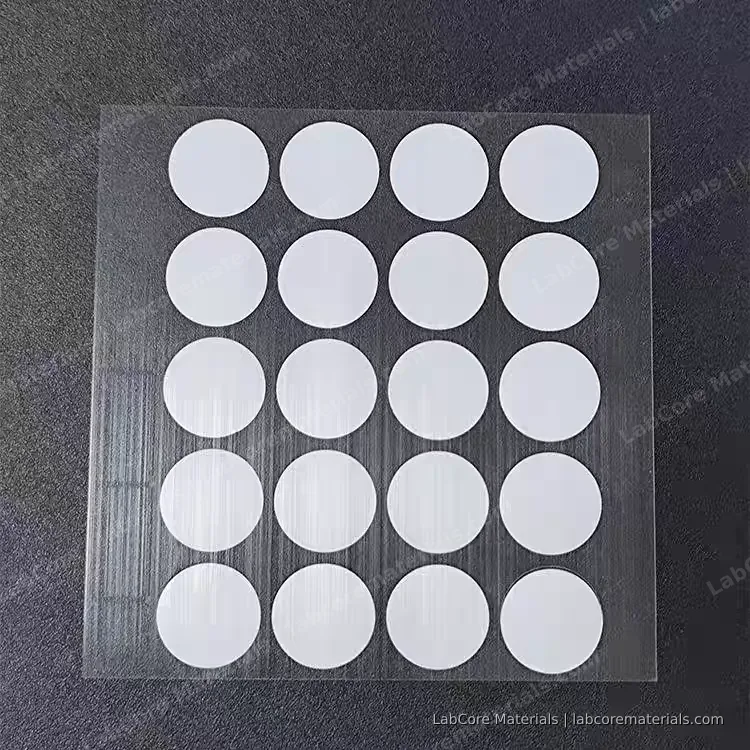
If you are cutting discs for coin cells, the same three grades are available pre-cut at 16–20 mm — see our separator disc family for the φ18 mm set (2320 / 2325 / 2500). For roll goods, the 25 µm grade comes as a 100 mm × 10 m roll for punch tools, and the 38 µm grade as the same format for pressure-bearing assemblies. Both rolls are vacuum-sealed and ship with handling cards.
Not sure which thickness your experiment needs? Request a quote with your cell format and stack pressure, and we will point you at the grade we would use ourselves.