
In March 2026, a team at Westlake University reported in Nature a result that moved anode-free lithium metal batteries out of the lecture-slide category: a 2.7 Ah anode-free Cu‖NCM811 pouch cell with 508 Wh/kg and 1668 Wh/L, cycled at an areal capacity of 5.6 mAh/cm², retaining 80% capacity over 250 cycles at 80% depth of discharge. For an architecture long confined to half-cells and small pouches, this is a substantive step.
Between a Nature paper and a working lab bench, however, sits a familiar gap. Most groups entering this direction will first meet something far less impressive: a Li‖Cu half cell whose Coulombic efficiency reads a respectable 99.5% — and a full cell that fades to 80% within forty-odd cycles. This article explains where that gap comes from, what the efficiency number hides, and how to set up measurements that expose the failure mechanism instead of merely recording it.
Why anode-free leaves no margin
An anode-free (or zero-excess) cell is built with no anode active material at all: the anode side is a bare copper foil. On first charge, lithium leaves the cathode and plates directly onto the copper; on discharge it strips back off. The anode is not manufactured — the cell generates it in situ, every cycle.
This is the theoretical ceiling of lithium-ion energy density: no graphite or silicon host, no excess lithium preloaded to buffer parasitic losses. The price is that every buffer is gone. In a conventional cell, anode excess and lithium inventory hide fractions of a percent of loss per cycle; in an anode-free cell, every fraction is charged directly against capacity.
The arithmetic is blunt. If lithium loss per cycle is proportional to cycled capacity, 99.5% Coulombic efficiency at 100% depth of discharge reaches 80% capacity in about 45 cycles; 99.9% stretches that to roughly 220; service life approaching conventional lithium-ion demands pushing efficiency past 99.95%. This is why, in the anode-free literature, a 0.05% efficiency improvement earns its own figure.
Coulombic efficiency is an average
A single number cannot describe how an anode-free cell dies, and two problems hide inside it.
The first is the measurement protocol itself. Adams et al. (Adv. Energy Mater., 2018) systematically analyzed the sources of systematic error in Li‖Cu Coulombic efficiency measurements: how much lithium is plated onto the copper, how much is stripped, and how the residual is treated — every one of these choices shifts the result. Efficiency values quoted in different papers are not always on the same footing. Align the protocol before comparing electrolytes.
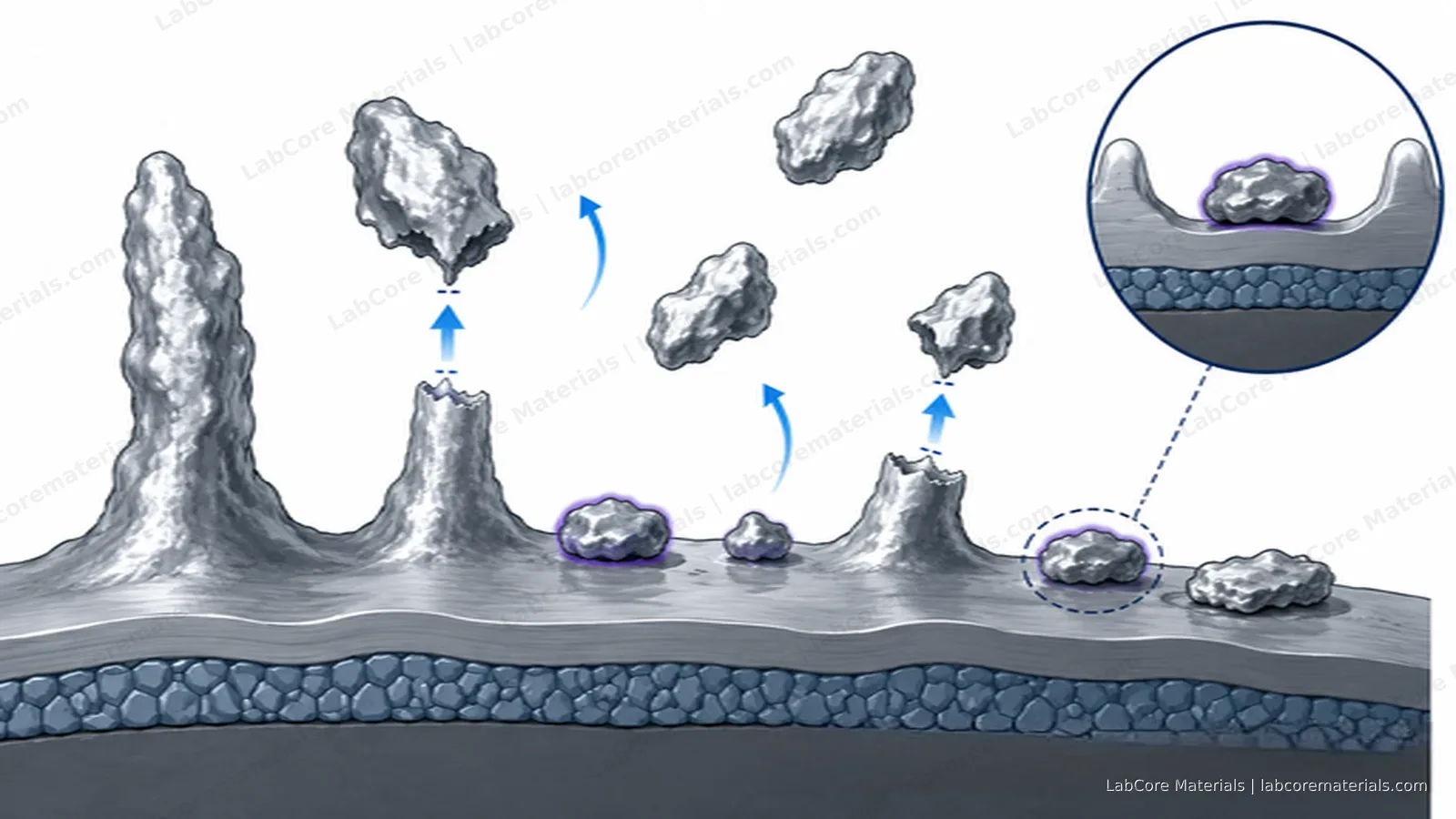
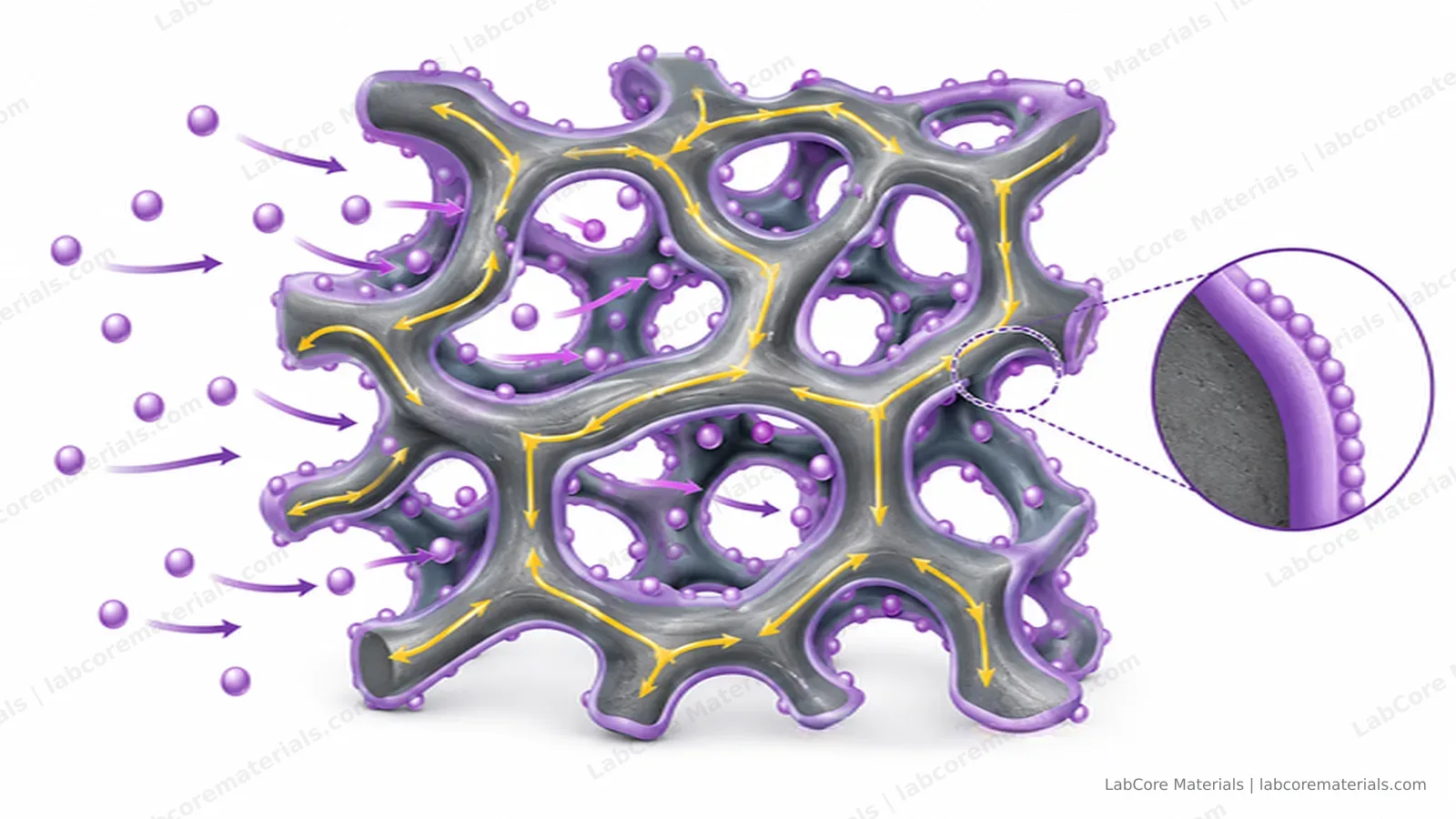
The second problem is that the average conceals the process. Coulombic efficiency answers how much lithium is lost per cycle, not what form the loss takes: whether the deposit thins uniformly, or breaks apart during stripping into electrically disconnected dead lithium; whether the SEI stays dense and stable, or fractures and reforms every cycle. Both scenarios can yield nearly identical efficiency values — yet they follow different failure paths and call for opposite fixes. One points to the electrolyte; the other, to the interface.
Morphology and interphase: the scene of the failure
Morphological evidence is not optional in this field. The dual-salt electrolyte work by Weber et al. (Nature Energy, 2019) set the template: rather than resting on efficiency numbers, the authors showed directly by electron microscopy that lithium deposited as a dense, dendrite-free layer in their electrolyte. The morphology is what makes the claim — that the electrolyte improved deposition uniformity — hold.
The 2026 Nature work pushed interphase characterization further. The BAFF electrolyte (LiDFOB in NDFA) builds a boron- and fluorine-rich polymer SEI on lithium with sub-nanometer uniformity; this flexible, rapidly lithium-conducting interphase guides lithium to deposit and strip in a nearly planar fashion. Post-mortem analysis attributed only 3.5% of capacity loss to dead lithium, far below the control electrolytes. Planarity matters because it minimizes freshly exposed surface: the more surface a deposit creates, the more lithium and electrolyte the SEI consumes, and the stronger the positive feedback toward porosity.
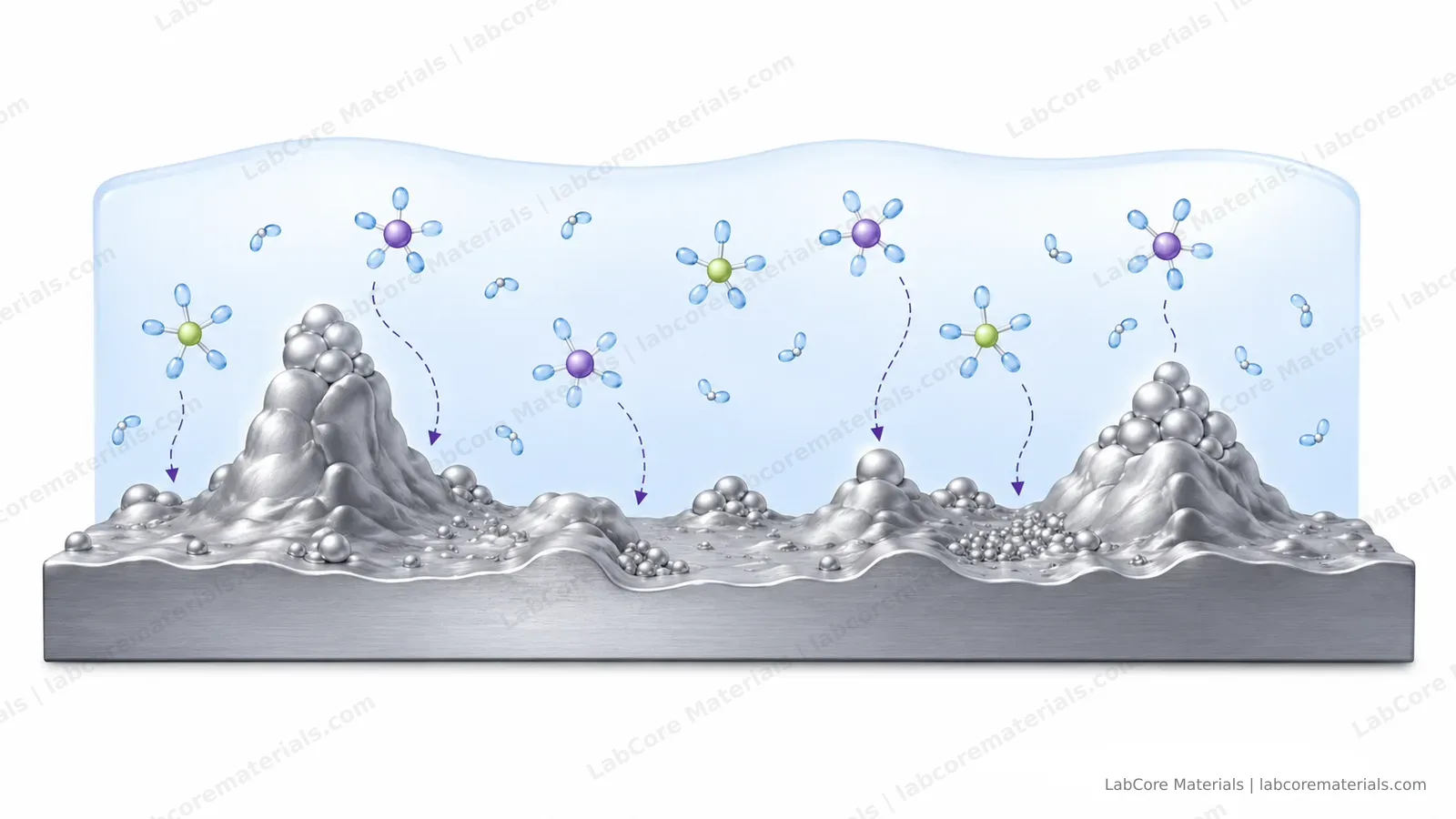
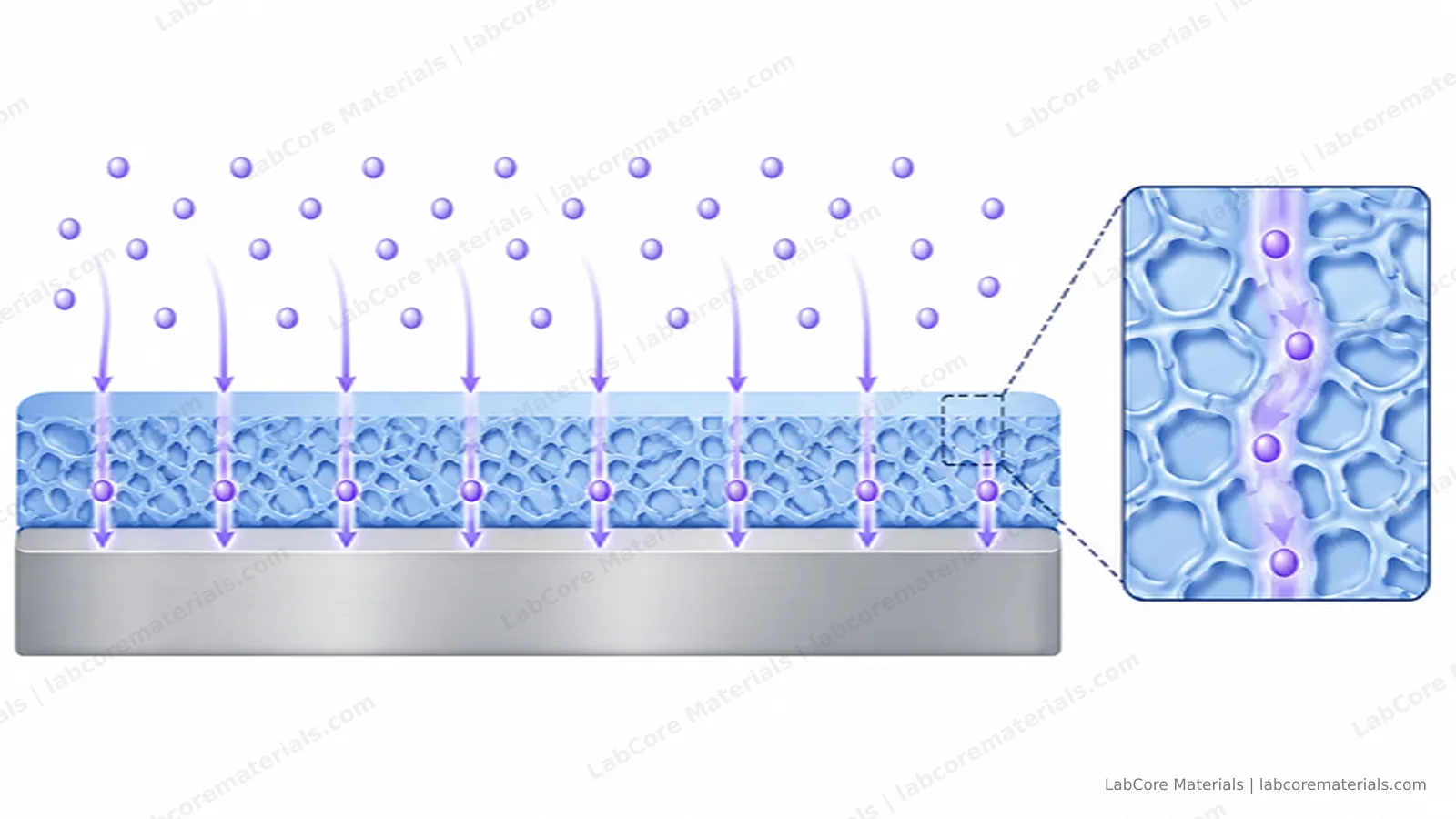
Current improvement strategies largely pursue one goal: controlling where lithium lands first, and in what form it grows. Interphase chemistry — artificial SEIs and functional electrolytes — steers deposition at the nucleation stage. Current-collector engineering — three-dimensional porous copper foils, lithiophilic seed layers — gives lithium a continuous host, at the cost of added mass that erodes part of the energy-density gain. Pressure management suppresses voids and mossy growth mechanically.
A four-layer measurement ladder for the lab
Translated into an executable sequence at the bench:
Layer 1: Li‖Cu coin cells — measure Coulombic efficiency. A CR2032 coin cell case kit plus separator discs is enough to start. Fix the areal capacity, the assembly pressure and the voltage window, and run every control group under one protocol — the inconsistency seen across the literature should be eliminated on your own bench first.
Layer 2: optical in-situ observation — see the morphology. An in-situ lithium dendrite observation cell with a sapphire window and a high-purity titanium base supports real-time microscopy during cycling: the transition from planar to mossy to dendritic deposition, and the locations where dead lithium forms, are directly visible. What happened morphologically in the cycle where the efficiency dropped no longer requires guesswork.
Layer 3: two-electrode cycling under pressure. A two-electrode battery test cell with a titanium body and spring-loaded contact, 20 mm electrodes, assembled in a glovebox and operated in ambient conditions. Anode-free cells are pressure-sensitive — plating and stripping drive large volume swings, and the spring keeps interfacial contact stable across the whole cycle.
Layer 4 (optional): interphase spectroscopy. An in-situ Raman two-electrode battery test cell tracks the evolution of interfacial species during cycling, triangulating with morphology and electrochemical data.
| Layer | Question answered | Setup |
|---|---|---|
| Coulombic efficiency | How much lithium is lost per cycle | CR2032 cases + separator discs |
| Morphology | In what form the loss occurs | Optical in-situ observation cell |
| Cycle life | Full-cell behavior under pressure | Two-electrode test cell |
| Interphase chemistry | How the SEI and interfacial species evolve | In-situ Raman two-electrode cell |
Application cases
| Source | Setup | Observation |
|---|---|---|
| Liu L, Xiang Y, Lu X, Wang J. Nature, 2026, 652: 1211–1218. DOI: 10.1038/s41586-026-10402-0 | Anode-free Cu‖NCM811 pouch cell, BAFF electrolyte (LiDFOB/NDFA), 5.6 mAh/cm² | Sub-nanometer-uniform B–F-rich SEI enables planar deposition/stripping; 508 Wh/kg; 80% retention over 250 cycles at 80% DOD; dead lithium 3.5% of capacity loss |
| Weber R, et al. Nat. Energy, 2019, 4: 683–689. DOI: 10.1038/s41560-019-0428-9 | Anode-free pouch cells, dual-salt liquid electrolyte | Dense, dendrite-free lithium morphology enabling long anode-free pouch cycling |
| Louli A J, et al. Nat. Energy, 2020, 5: 693–702. DOI: 10.1038/s41560-020-0668-8 | Failure diagnosis of anode-free pouch cells | Combined electrolyte quantification and morphological analysis; electrolyte depletion identified as a life-limiting factor |
| Adams B D, et al. Adv. Energy Mater., 2018, 8: 1702097. DOI: 10.1002/aenm.201702097 | Methodology of Coulombic efficiency measurement on Li‖Cu cells | Systematic analysis of protocol-induced errors and recommended practices |
Conclusion
The anode-free architecture compresses lithium inventory into a single, non-replenishable variable, so the form of each cycle's loss — uniform thinning, dead lithium formation, or interphase growth — directly determines cell life. Coulombic efficiency, as an integrated quantity, is suitable for screening electrolytes and current-collector designs; establishing the correspondence between loss mechanisms and interphase chemistry, however, requires supplementary morphological and spectroscopic evidence. Aligning electrochemical, morphological and interfacial data under a unified protocol provides a mechanistic basis for electrolyte design, current-collector engineering and stack-pressure optimization.