
LabCore Materials
Nickel Foam Electrode Substrate | High Porosity for Batteries
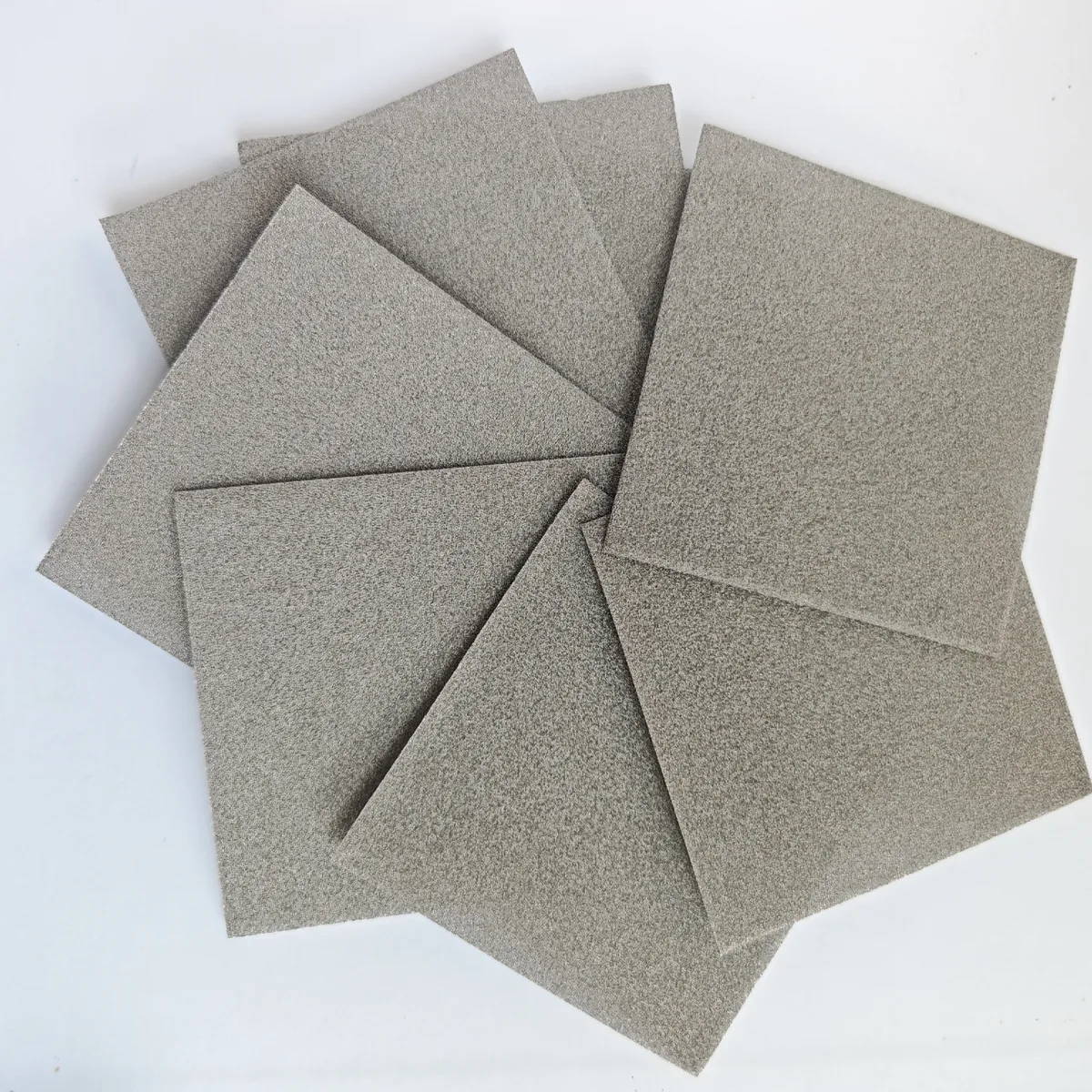
Pure nickel foam sheets for electrode substrates. High porosity (95-98%) and conductivity. Ideal for supercapacitors and battery research. Custom sizes available.
Order / Quote
| Model | Pack | Price | Action |
|---|---|---|---|
| NF-110-1PIn stock | Nickel Foam, 1 sheet1 sheet per pack, 100 × 100 mm | As listed on Amazon | 100+ units: request wholesale pricing → |
| NF-110-2PIn stock | Nickel Foam, 2 sheets2 sheets per pack, 100 × 100 mm each | As listed on Amazon | 100+ units: request wholesale pricing → |
Specifications
| Parameter | Value | Unit |
|---|---|---|
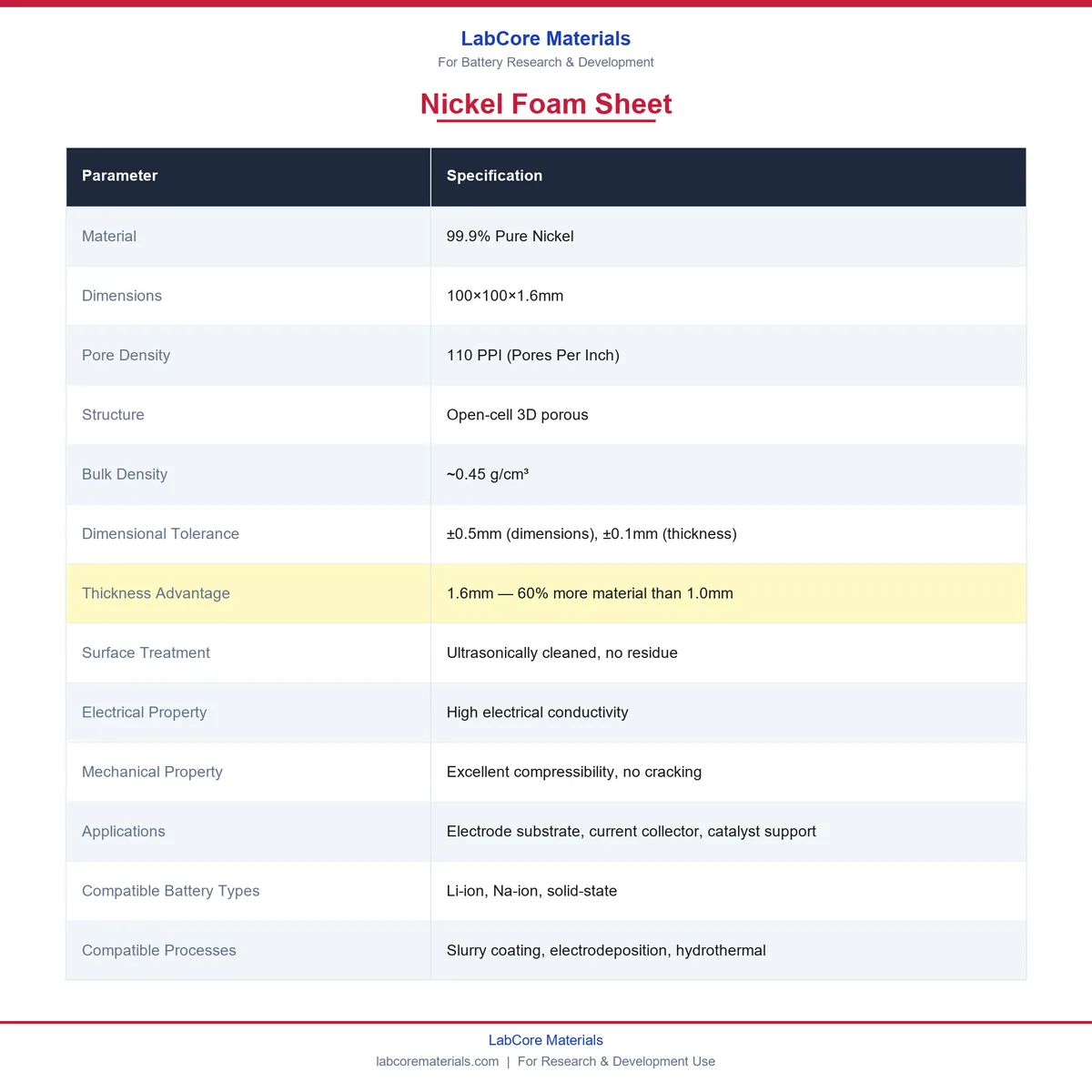
| Dimensions | 100 × 100 | mm |
| Thickness | 1.6 | mm |
| Material | Pure nickel |
Product Images
Shipping & Compliance
- Ships as raw material. No electrolyte, no lithium. Not classified as dangerous goods.
FAQ
Does nickel foam need pretreatment before use?
Pretreatment is strongly recommended. As-received nickel foam has surface oxides and residual oils that impair active material loading and conductivity. Standard procedure: ① Acetone sonication (10 min, degreasing) → ② 3M HCl immersion (15 min, oxide removal) → ③ DI water rinse until pH neutral → ④ Anhydrous ethanol rinse → ⑤ Vacuum dry at 60°C for 12 hr.
What does 110 PPI mean?
PPI = Pores Per Inch, a measure of foam density. 110 PPI means ~110 pores per inch, with pore sizes around 200-300 μm. Higher PPI increases surface area (better for active material loading) but reduces porosity and increases electrolyte diffusion resistance. 110 PPI strikes a balance for supercapacitors and battery electrodes.
How do I load active materials onto nickel foam?
Three common methods: **① Slurry coating** (most common): Mix active material, conductive additive, and binder into a slurry, then coat or dip the foam. Dry and press. Works for NiO, MnO₂, activated carbon, etc. **② Hydrothermal/solvothermal**: Immerse foam in precursor solution and react at high temperature/pressure to grow nanostructures (e.g., Ni(OH)₂ nanosheets) directly on the surface. Strong adhesion but requires specialized equipment. **③ Electrodeposition**: Use foam as working electrode to deposit active materials (e.g., MnO₂, Co(OH)₂) electrochemically. Precise thickness control but slower.
Can nickel foam be used as a lithium-ion battery anode?
Not directly as anode material, but as an **anode current collector**. Traditional Li-ion anodes use copper foil, but nickel foam's 3D structure can host more active material (Si, Sn, CNTs), increasing areal capacity. Caution: nickel alloys with lithium at low potentials—add a carbon coating between the foam and active material, or use copper foam instead.
How many electrodes can I cut from a 300×300 mm sheet?
Depends on electrode size: - φ10 mm discs: ~700 pieces - φ15 mm discs: ~300 pieces - 10×10 mm squares: ~800 pieces - 20×20 mm squares: ~200 pieces Use a punch cutter or laser—scissors flatten edges and degrade performance. Leftover scraps work for small-scale tests or as conductive additives.